
The Ultimate Guide to Buying a 3D Scanner
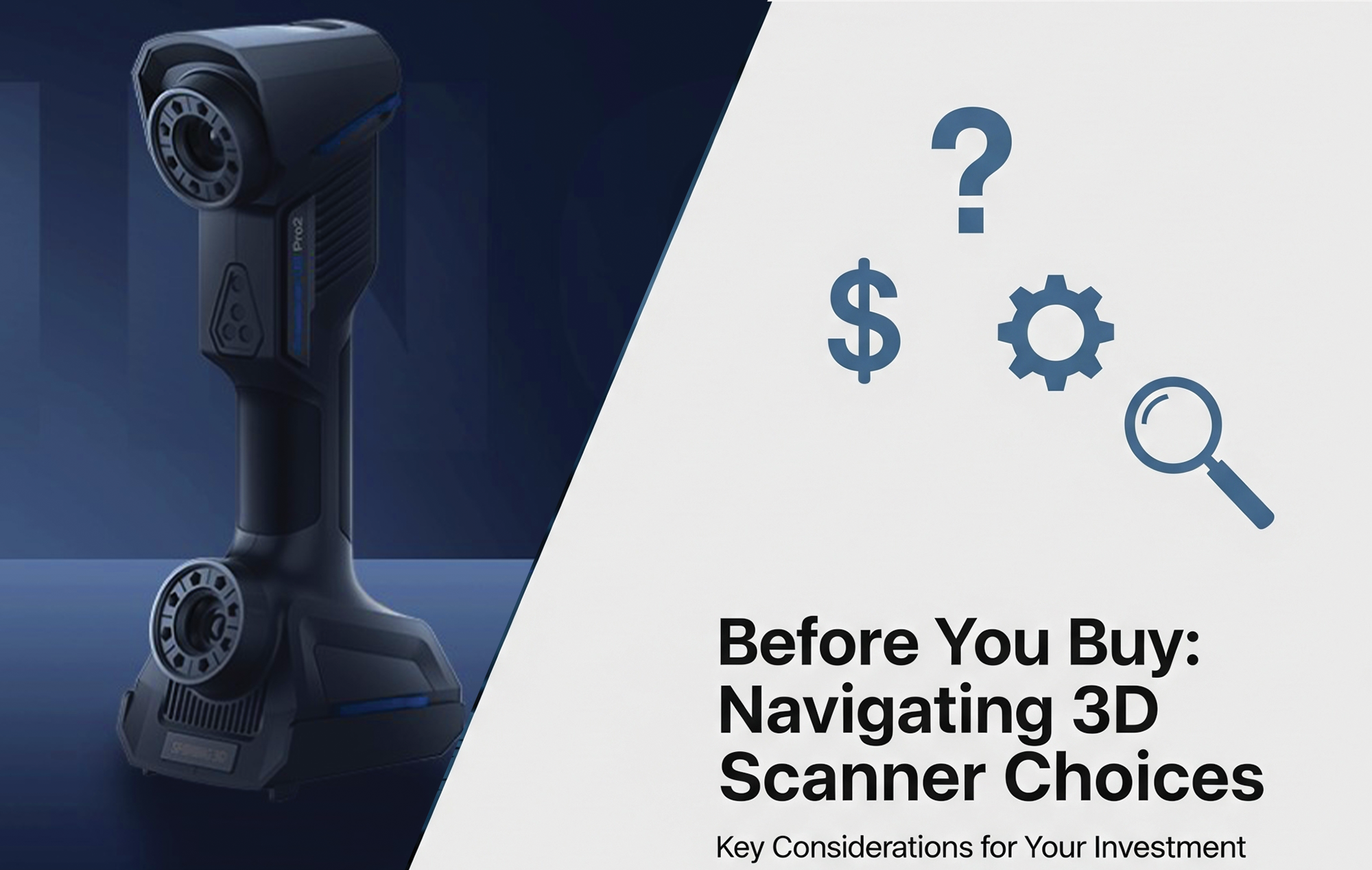
Searching for the right 3D scanner? It’s not as simple as picking the fanciest model. To make a wise choice, start by asking the right questions:
- What is the average size of objects you need to scan?
- What kind of surface materials are you dealing with?
- What resolution do you need and what is the accuracy level you are looking for?
- Your budget?
Let’s unpack these factors and see their affect on your decision.
1. Field of View (FOV)
The scanner’s vision range is called FOV, i.e., the magnitude of the area it can capture in one shot. Choosing the right FOV ensures efficient scanning.
If the scanner is too small, you may need mmultiple scans of the same object to cover large items. It will become time consuming, labour-intensive and inefficient.
Too large? You may miss finer details on small, intricate objects.
- Small objects → choose scanners with a narrow FOV
- Large objects → look for models with a broader FOV
2. Surface Material
Surfaces like shiny metal, transparent glass, or dark materials can be challenging for scanners. Some scanning technologies tick these boxes better than others.Evaluate your target object materials before selecting a scanner.
3. Resolution vs. Accuracy
Resolution essentially refers to the detail level of the scan. Higher resolution captures finer textures but takes more time.
Accuracy defines how true the captured points are to the real-world dimensions which is critical for inspection and reverse engineering workflows. Choose based on your precision needs rather than defaulting to the highest specs.
4. Budget
Scanners have a broad price range. Balance what you really need – size, detail, surface adaptability, and precision – with your budget. Matching features to use-case yields the best RoI.
Quick Reference Table
| Question to Ask | Why It Matters |
| What size object will you scan? | Ensures you choose the right Field of View (FOV) |
| What material is the object surface? | Certain materials require specific scanning tech |
| What resolution do you need? | Determines the detail level of your scans |
| What level of accuracy is required? | Essential for precise applications like inspection or CAD |
| What’s your budget? | Guides selection toward the most cost-effective option |
Takeaway
Start smart with thoughtful questions. By understanding your scanning needs across object size, surface type, resolution, accuracy and budget, you’re more likely to choose a scanner that fits your workflow; saving time, money and frustration.
Interested in Field Scanning Services?
Reach out to OTS 📩 [email protected] | 🌐 www.otspk.com