Challenge
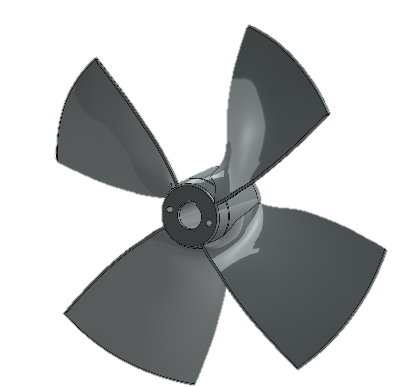
Marine propulsion systems rely heavily on precisely manufactured propellers to ensure efficient thrust, fuel economy, and operational stability. In this case, a shipyard supporting Pakistan Navy operations required digital reconstruction of a marine propeller for repair evaluation and academic study. The available propeller lacked updated engineering documentation, including CAD models and detailed drawings. Additionally, the complex curved blade surfaces and wear-induced deviations made conventional measurement methods unreliable. The objective was to capture the complete propeller geometry using high-precision 3D scanning, develop an accurate CAD model through reverse engineering, and generate engineering documentation suitable for refurbishment, performance analysis, and educational reverse engineering applications.
Solution
A structured 3D scanning and reverse engineering workflow was applied to accurately digitize and reconstruct the propeller.
- The propeller was scanned using a high-precision 3D scanning system to capture detailed blade geometry.
- The scan data was aligned and merged to generate a complete point cloud model.
- Scan data was aligned and processed into a high-density point cloud
- Surface reconstruction converted scan data into smooth and accurate CAD geometry.
- A fully parametric CAD model of the propeller was developed for engineering use.
- The digital model can be used for reverse engineering training and marine engineering studies.