

Case Details
Case Study : Racing Car Cooling System Optimization through Metal Additive Manufacturing
Sector: 3D Printing
Category: Rapid Prototyping
Download Case Details
Download a detailed report on this case
Challenge
In high-performance electric racing vehicles, the cooling system plays a critical role in overall efficiency, reliability, and race performance. During the development of a Formula Electric race car by the Harbin Institute of Technology (Weihai) team, several challenges were identified:
- The conventional condenser design required multiple welded components, making manufacturing complex, time-consuming, and prone to coolant leakage.
- Traditional cooling jacket production involved multi-part assemblies, combining CNCmachined aluminum and plastic 3D-printed components, increasing the risk of poor water tightness and structural weakness.
- Strict motorsport requirements demanded high heat dissipation, lightweight structures, and reliable internal flow channels, which were difficult to achieve using traditional manufacturing methods.
To remain competitive in Formula Student China, the team required a more efficient, integrated and performance-driven cooling solution.
Solution
OTS’s technology partner, E-Plus 3D, supported the racing team by redesigning and optimizing the cooling system using metal 3D printing.
Integrated Condenser Design
- The original multi-part welded condenser was redesigned as a single integrated structure.
- Using the E-Plus 3D EP-M250 metal 3D printer, the condenser was produced in aluminum alloy, eliminating weld joints and leakage risks.
- Advanced design optimization improved internal flow paths and surface area for heat dissipation.
3D-Printed Motor Cooling Jacket
- Engineers redesigned the cooling jacket to meet demanding thermal and mechanical requirements.
- Design considerations included:
o Motor heat output and average power o Heat flux density o Local temperature distribution o Structural strength, weight reduction, and ease of maintenance
- Water flow simulations were performed to optimize internal channels, maximizing temperature difference between inlet and outlet while ensuring uniform cooling.
- The final design was manufactured using the EP-M250 metal 3D printer, followed by heat treatment and sandblasting.
Benefits
The deployment of metal additive manufacturing through OTS and E-Plus 3D delivered clear engineering and performance advantages:
- Enhanced Cooling Performance:
Optimized internal flow channels significantly improved heat dissipation efficiency.
- Reduced Component Temperature:
The newly designed condenser achieved a temperature reduction of approximately 10°C compared to previous race versions.
- Improved Structural Integrity & Water Tightness:
One-piece metal components eliminated assembly interfaces, reducing leakage risks and improving durability.
- Lightweight & Complex Geometry:
Metal 3D printing enabled lightweight designs with complex internal structures that are impossible with conventional methods.
- Faster Production Cycles:
Additive manufacturing reduced lead times and simplified production compared to multistep traditional manufacturing.
Results
Following assembly and testing, the optimized cooling system was successfully integrated into the race car. The results were evident on the track:
- The race car performed reliably under high thermal loads.
- Improved cooling efficiency contributed to stable motor operation and enhanced overall performance.
- The Harbin Institute of Technology (Weihai) racing team secured 3rd place at the 2018 Formula Student China Electric Race in Zhuhai.
Through this project, OTS’s technology partner demonstrated how metal 3D printing unlocks new design freedom, performance optimization, and manufacturing efficiency for high-performance automotive and motorsport applications; setting the foundation for broader adoption across the automotive industry.
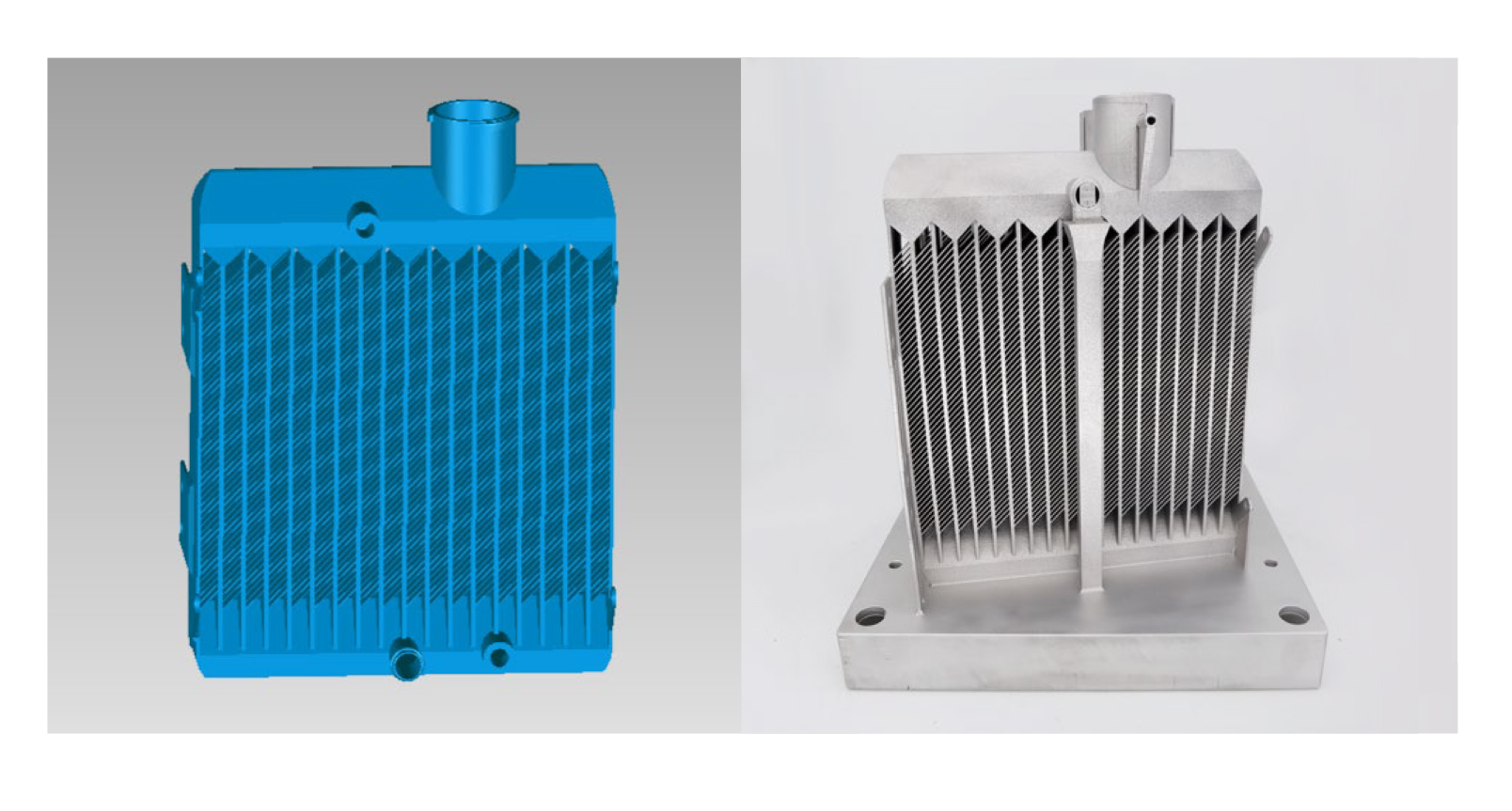
Figure: 3D data of the optimized condenser and the metal 3D printed racing car part