
Case Details
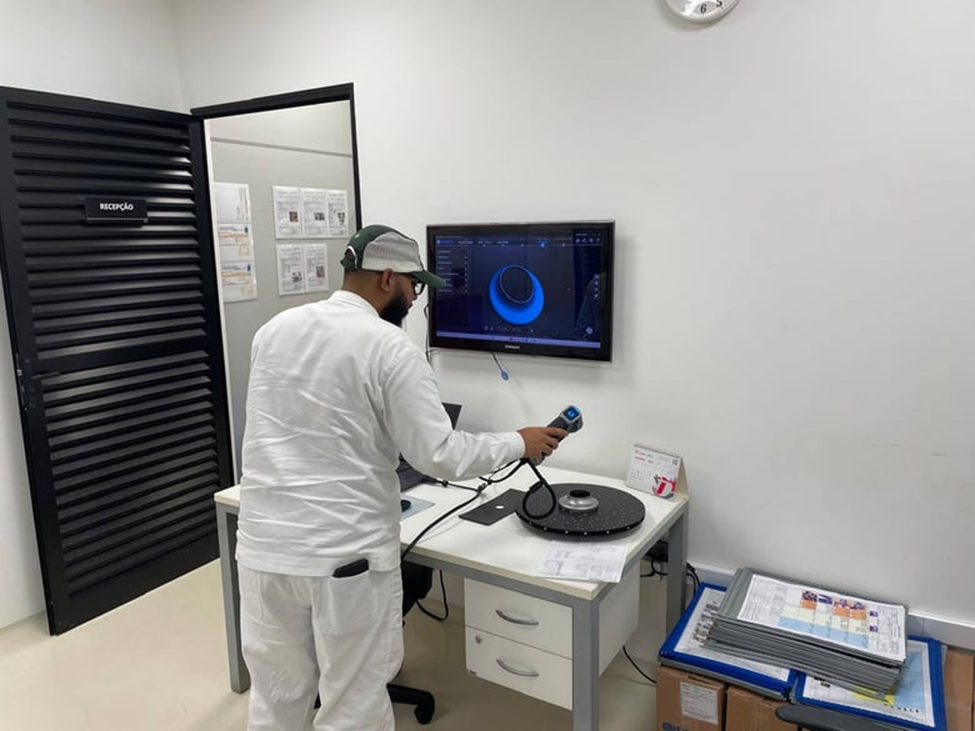
Case Study : How 3D Scanning Helps Improve Automotive Exhaust Converter Inspection
Sector: 3D Printing
Category: Rapid Prototyping
Download Case Details
Download a detailed report on this case
Challenge
As industries pursue higher safety standards and performance, conventional automotive and electronics components face limitations in both fire protection and design flexibility. Traditional materials and manufacturing methods often cannot meet stringent flame-retardancy requirements without compromising mechanical properties, production lead time or cost. In electric vehicles (EVs), safety-critical parts, such as battery housings, electrical modules and structural components, must resist ignition and flame propagation under harsh conditions, making material selection crucial for product reliability and compliance.
Solution
OTS’s technology partner implemented advanced 3D printing with flame-retardant engineering nylon to overcome these challenges. Using high-performance flame-retardant nylon (e.g., UL94 V-0 rated nylon 12 formulations), the production of functional, safety-critical components with enhanced fire resistance and structural integrity was enabled.
Through Selective Laser Sintering (SLS) and other industrial additive manufacturing techniques, OTS can directly produce parts with complex geometries that would be difficult or costly with traditional processes. These materials are engineered to deliver:
- UL94 V-0 flame retardancy, helping prevent flame spread
- Excellent mechanical strength and wear resistance
- Retained structural performance at elevated temperatures
- Compatibility with rapid digital production workflows
This approach supports safety-critical applications across sectors — from consumer electronics housings to EV battery module frames.
Benefits
By adopting flame-retardant nylon and 3D printing, multiple operational and technical advantages were delivered:
Enhanced Safety
- Flame-retardant materials meet stringent fire safety standards, making components safer for end-use in EVs, electrical enclosures and under-hood automotive environments.
Design Freedom
- Complex geometries, integrated features and optimized part structures are achievable without tooling constraints. This enables both performance and safety features in a single printed part.
Faster Time-to-Production
- Digital workflows significantly reduce lead times compared with mold-based or CNC approaches, with parts producible in hours rather than weeks.
Cost Efficiency
- Eliminating custom tooling and enabling rapid iteration cuts overall development cost, particularly for prototypes and low-to-mid volume runs.
Results
OTS’s flame-retardant nylon 3D printing solutions have delivered measurable impact:
- Improved Fire Performance: Components produced with flame-retardant nylon resist ignition and slow flame propagation, enhancing safety in applications such as battery module housings and electrical connectors.
- Reduced Production Lead Times: Rapid additive workflows compress development cycles, enabling faster validation and production turnover.
- Material Versatility: The high mechanical strength and thermal stability of flame-retardant nylon expand use cases from consumer electronics to EV powertrain components.
- Lightweight and Efficient Design: Compared to traditional materials, the 3D printed parts achieve both weight savings and flame safety; a key advantage for EV design optimization.
By integrating material innovation with digital manufacturing, more capable components are manufactured for modern industrial challenges, thus bridging performance, safety and production efficiency in next-generation products.