

Case Details
Case Study : SLS 3D printing by Dongfeng Motor Group
Sector: 3D Printing
Category: Rapid Prototyping
Download Case Details
Download a detailed report on this case
Challenge
Automotive R&D and prototype production are traditionally slow, costly and heavily dependent on external suppliers for tooling, machining and plastic part fabrication. Typical processes such as injection molding or CNC machining can take weeks per iteration and carry risks of intellectual property leakage when prototypes are sent outside the organization. These hurdles slow innovation, increase development costs, and reduce control over product design and quality; especially during trial production and functional verification stages of new automotive models.
Solution
OTS’s technology partner, TPM3D, partnered with automotive innovators to introduce Selective Laser Sintering (SLS) 3D printing into the R&D and production workflows for prototype and lowvolume parts. By leveraging industrial SLS systems and high-performance nylon materials, in-house manufacturing of complex automotive components was carried out, eliminating dependency on traditional molding and external suppliers.
Key elements of the solution included:
- In-house 3D printing of prototype components such as central control panels and distribution box shells, using glass-fiber reinforced and standard nylon materials for durability and high surface quality
- Digitally driven manufacturing workflows, converting CAD designs directly into production-ready parts without tooling
- Material selection optimized for automotive use, maintaining mechanical performance suitable for fit, alignment, and assembly testing
- Streamlined internal prototyping process, reducing reliance on outsourcing and long supplier lead times
Benefits
By integrating SLS 3D printing into automotive development cycles, multiple operational and engineering benefits are:
Faster Development Cycles
Prototypes that once required two to three weeks with external vendors can now be printed and delivered in as few as four days, accelerating verification of assembly fit, ergonomics, and design intent.
Reduced Outsourcing Risk
Producing parts internally eliminates dependency on third-party suppliers during sensitive R&D stages, reducing the risk of intellectual property leakage and ensuring confidentiality for new vehicle designs.
Cost Efficiency
By avoiding costly injection molding or CNC machining for prototype runs, OEMs and engineering teams can significantly cut prototype fabrication costs and reallocate budget to design iterations and performance testing.
Design Flexibility
SLS enables complex geometries, integrated assemblies, and tool-free iterations; expanding what engineers can prototype and test without traditional manufacturing constraints.
Results
With OTS’s SLS 3D printing solutions in place, automotive teams achieved measurable improvements:
- Accelerated R&D turnaround, with prototype part cycles reduced from weeks to days
- Reduced development costs, particularly for low-volume plastic components that previously required expensive tooling
- Increased control and confidentiality during critical design phases
- Enhanced prototyping capability, enabling more design iterations and better early-stage decision making
By embedding industrial 3D printing into the vehicle development lifecycle, automotive partners can easily transform R&D and prototype production, setting the stage for faster innovation and more efficient production readiness across future models.
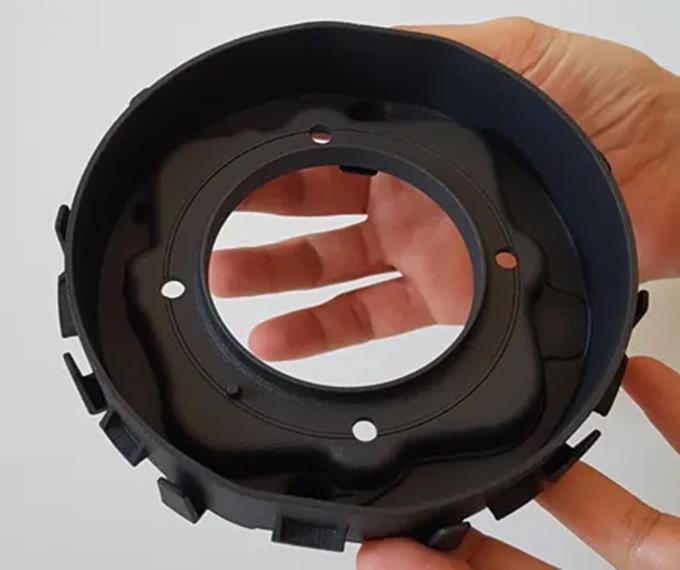
Figure: Carbon fiber-reinforced airbag housing, 3D-printed by Joyson Safety Systems using SLS technology