
Case Details
Case Study : 3D Printing Redefining the Japanese Automotive Industry Challenge
Sector: 3D Printing
Category: Rapid Prototyping
Download Case Details
Download a detailed report on this case
Challenge
The automotive industry places exceptionally high demands on performance, precision and flexibility. OEMs and component manufacturers require high-performance materials and fast iteration cycles, especially when producing customized or low-volume components.
For companies like SANKI Co., Ltd., a Japanese manufacturer specializing in special vehicle cabins and compartment-related components, traditional manufacturing posed major challenges:
- Injection molding was not cost-effective for limited production volumes, resulting in extremely high per-unit costs.
- Long tooling lead times restricted design flexibility and rapid modification.
- Custom components such as air-conditioning and ventilation vents for special vehicles were not available off-the-shelf.
- Producing complex inspection and testing fixtures using conventional machining resulted in long production times and high costs.
SANKI required a manufacturing solution that could deliver cost efficiency, design freedom and fast turnaround without compromising performance.
Solution
OTS’s technology partner introduced additive manufacturing solutions to support customized production and tooling for automotive applications.
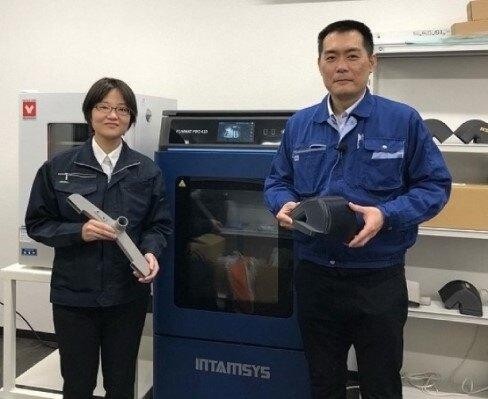
Using the INTAMSYS FUNMAT PRO 410, SANKI successfully transitioned from traditional manufacturing to industrial-grade 3D printing:
- Large Build Volume:
The FUNMAT PRO 410 offers a build volume of 305 × 305 × 406 mm, enabling production of large and complex automotive components in a single build. - Open Material System & Soluble Supports:
Support for water-soluble materials allows the production of complex internal geometries, ideal for air-conditioning and ventilation parts. - High Precision & Speed:
Linear guides and a high-performance drive system ensure high-speed, high-accuracy printing, reducing production cycles significantly. - Advanced Materials:
Components were printed using glass-fiber-reinforced nylon (PA-GF) and PC-ABS, offering enhanced strength, thermal stability and reduced deformation.
In addition to end-use parts, the same system was used to 3D print testing and inspection fixtures for automotive piping components.
Benefits
The adoption of 3D printing technology delivered significant advantages:
- Major Cost Reduction:
Injection molding costs were estimated at tens of millions of yen (over USD 100,000), while 3D printing dramatically lowered production expenses for small batches. - Faster Design Iteration:
Engineers gained the ability to modify designs quickly without tooling changes, accelerating development cycles. - High-Performance Materials:
PA-GF provided improved tensile strength, bending strength, heat resistance and dimensional stability compared to conventional plastics. - Rapid Fixture Production:
Inspection jigs and testing fixtures that previously required long machining times were produced much faster, improving productivity and efficiency. - Manufacturing Flexibility:
3D printing enabled both custom end-use parts and tooling within the same production ecosystem.
Results
By integrating industrial 3D printing into automotive workflows, OTS and INTAMSYS enabled Japanese automotive manufacturers to achieve:
- Efficient small-batch production of customized air-conditioning and ventilation components for special vehicles.
- Significantly reduced lead times for both functional parts and testing fixtures.
- Improved production efficiency and quality, supporting disaster-relief and emergency-response vehicle programs.
- A scalable, future-ready manufacturing approach that supports customization, cost control and innovation.
This case demonstrates how industrial 3D printing solutions enable automotive manufacturers to move beyond traditional constraints, redefining how customized parts, tooling and fixtures are designed and produced.